


Uvamai Niche Tourism
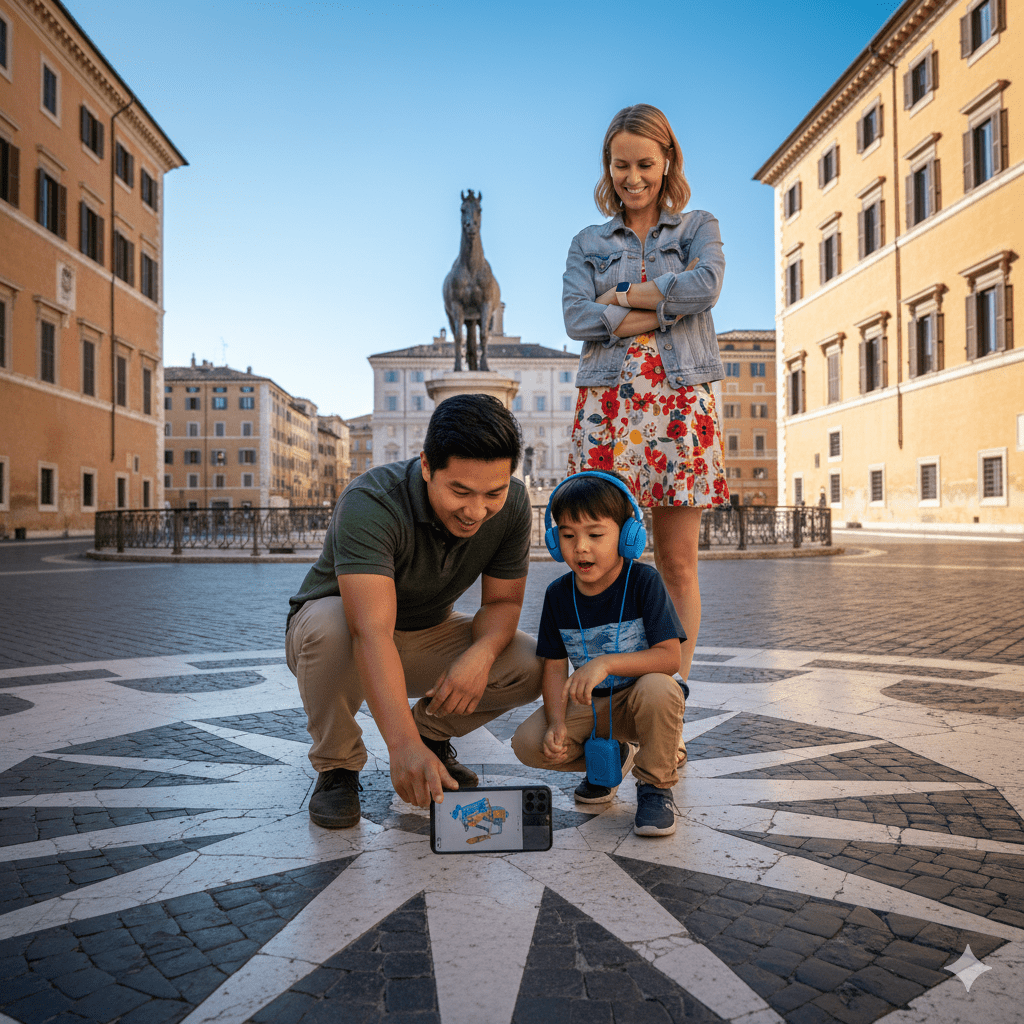
Rome Self-Guided Audio Tour
Rome Self-Guided Audio Tour
Impossibile caricare la disponibilità di ritiro
Rome Self-Guided
Audio Tour
The Eternal City · Where Empires Rise and Popes Reign
22 expertly narrated audio guides · Ancient ruins, Baroque piazzas & hidden chapels · Explore at your own pace · From $6 per person
⚡ Instant Digital Download · 12 Languages · 6-Day AccessWalk through 2,800 years of layered history with our comprehensive self-guided audio tour of Rome, featuring 22 expertly narrated audio guides covering the city's ancient ruins, Renaissance palaces, and Baroque masterpieces. This digital download includes instant access to professionally recorded narration, an interactive map, and complete walking guidance that let you explore the Eternal City at your own pace, in your own order.
From the still-standing dome of the Pantheon to the coin-strewn waters of the Trevi Fountain, from the political theatre of the Roman Forum to the hidden cannonball lodged in Palazzo Colonna's marble steps — every audio guide uncovers the details guidebooks skip and tour buses rush past. Perfect for independent travellers who want the depth of a scholar's knowledge without the constraints of a fixed group schedule.
What Is This Product?
A digital PDF delivered instantly to your email — containing everything you need for an exceptional self-guided audio tour of Rome.
- PDF with 22 SoundCloud streaming links
- Interactive Google My Maps
- Walking routes & navigation tips
- 6-day unlimited access
- 12 language options
- 24/7 technical support
- NOT a physical product
- NOT a live guided tour
- NOT downloadable audio files
- NOT museum or site admission tickets
- NOT transport included
- NOT a GPS navigation system
22 Attractions with Audio Guides
Every stop comes with expert narration revealing history, hidden details, and stories most visitors never hear. Audio durations shown are approximate — actual length may vary slightly depending on your selected language.
Discover how Mussolini-era architects wove the 4th-century Servian Wall directly into the station's foundation, and why two rival design firms ended up sharing credit for its dramatic curved facade. Your guide reveals the underground passages popes once used to slip away from Vatican intrigue, turning Rome's busiest transport hub into a monument where ancient ruins, Fascist-era ambition, and modern Italian design collide.
Hear the miraculous legend of an August snowfall in 358 AD that supposedly outlined exactly where Pope Liberius should build this sacred basilica. Inside, your narrator points you toward 5th-century mosaics that have survived seventeen centuries intact, a coffered ceiling said to be gilded with the first gold brought back from the Americas, and relics of the Holy Crib preserved beneath the altar.
Trace the decades-long saga between Michelangelo and Pope Julius II that produced the legendary Moses sculpture — including the mistranslation that gave the prophet his famous horns. Your narrator also explains the chains said to have bound St. Peter in prison, which tradition holds miraculously fused together when reunited, giving this basilica its name.
Learn why this basilica, not St. Peter's, is technically the Pope's true cathedral and the mother church of Roman Catholicism. Built on land confiscated from the disgraced Laterani family and rebuilt repeatedly after fires, earthquakes, and barbarian sacks, the site also holds the Holy Stairs — steps pilgrims still climb on their knees, believed to be the very ones Christ walked before Pilate.
Watch scattered stones and broken columns transform into the living center of Roman power, where Caesar was cremated and Mark Antony delivered his famous funeral oration. Your guide walks you past the Temple of Saturn, which once housed Rome's treasury, the House of the Vestal Virgins, and the Arch of Septimius Severus — propaganda carved permanently in stone.
Explore Michelangelo's final architectural masterpiece, designed at age 70 as a geometrically perfect oval that plays optical tricks on the eye. Commissioned by Pope Paul III to impress Holy Roman Emperor Charles V, the piazza is anchored by a bronze equestrian statue of Marcus Aurelius and the sweeping Cordonata staircase that announces the hill's authority before you even reach the top.
Discover how Pope Sixtus IV's shrewd 1471 gift to the Roman people launched what's considered the world's oldest public museum collection. Inside await the Capitoline She-Wolf, with Renaissance-era twins added centuries after the original bronze — myth-making captured in metal — the Dying Gaul, colossal fragments of a statue of Constantine, and tales of Napoleon's plundering that briefly emptied these halls.
Stand before the polarising "Wedding Cake" monument, a building Romans both admire and resent for its overwhelming presence in the historic skyline. Built to celebrate Italian unification at the cost of an entire medieval neighbourhood, the site also holds the Tomb of the Unknown Soldier and, at the adjacent Palazzo Venezia, the balcony from which Mussolini delivered speeches that changed the course of European history.
Meet a family that has occupied this palazzo continuously since the 13th century and still opens its private galleries only on Saturday mornings. Your guide recounts bitter feuds with the Orsini family, a Colonna pope, Martin V, and points out a cannonball still embedded in the gallery's marble steps from an 1849 siege — all beneath frescoes in the Hall of Columns celebrating the Battle of Lepanto.
Step into the union of two of Rome's greatest dynasties — the Doria naval heroes of Genoa and the Pamphilj papal line — joined through marriage inside one private palazzo. Your narrator lingers on Velázquez's penetrating portrait of Pope Innocent X, which the pope himself reportedly called "too truthful," Caravaggio's haunting Penitent Magdalene, and a Gallery of Mirrors built to rival Versailles.
Learn why this theatrical fountain nearly bankrupted papal coffers, and how Nicola Salvi's design terminates the ancient Aqua Virgo aqueduct, still flowing since 19 BC. Neptune commands sea horses representing the ocean's changing moods while Tritons wrestle them into place — and your guide walks you through the coin-toss ritual said to guarantee your return to Rome: right hand, over the left shoulder.
Stand beneath Andrea Pozzo's trompe-l'oeil ceiling fresco, a soaring dome that in reality does not exist — an ingenious solution to budget and engineering limits that became one of art history's most convincing architectural deceptions. Your narrator directs you to the brass disk marked on the nave floor, the exact spot where Pozzo's perspective mathematics snaps perfectly into place.
Stand beneath the world's largest unreinforced concrete dome — nearly 2,000 years old and still studied by modern architects for its perfect proportions, where height equals diameter to form a flawless sphere. Built under Emperor Hadrian around 126 AD, the concrete itself is engineered to shift from heavy travertine at the base to lightweight pumice near the top, while the open oculus pours light across the interior like a slow-moving celestial sundial.
See three Caravaggio masterpieces still hanging in their original setting, including The Calling of St. Matthew, where Christ's outstretched gesture deliberately echoes Michelangelo's Creation of Adam. Your guide explains how the artist's revolutionary use of chiaroscuro — dramatic light against deep shadow — changed the direction of Western painting, and how his own violent, turbulent life fed directly into that intensity.
Walk the exact footprint of Emperor Domitian's ancient stadium, preserved in this elongated Baroque square that once held 30,000 cheering Romans watching foot races. Bernini's Fountain of the Four Rivers dominates the center, its four figures representing the Nile, Ganges, Danube, and Río de la Plata beneath an Egyptian obelisk symbolising papal power stretching across continents.
Trace this architectural shapeshifter from Hadrian's monumental tomb, completed in 139 AD, through its later lives as papal refuge, prison, treasure vault, and barracks. Named for a 6th-century vision of Archangel Michael sheathing his sword to end a plague, the fortress connects to the Vatican through the secret Passetto corridor that saved several popes' lives — and once held the sculptor Cellini and philosopher Bruno as prisoners.
Climb the 138 travertine steps that resolved centuries of French–Spanish diplomatic rivalry through pure Baroque choreography, designed by Francesco de Sanctis and completed in 1725. Your guide points out the sinking boat fountain at the base by Bernini's father, Pietro, and the house alongside where the poet Keats spent his final tragic months — a scene each spring transformed by cascading azaleas.
Explore what began as Cardinal Scipione Borghese's exclusive 17th-century playground — exotic animals, elaborate fountains, invitation-only guests — now transformed into the democratic public gardens Romans cherish today. Your narrator guides you past the Egyptian-style lake, the Temple of Aesculapius, hidden architectural follies, and the Pincian Hill terrace offering one of Rome's most photographed sunset views.
Enter a gallery that admits only 360 visitors per two-hour block, built on a collection Cardinal Scipione assembled through manipulation, cajoling, and the occasional outright theft. Your guide brings Bernini's Apollo and Daphne to life at the precise instant of mythological transformation, walks you past Caravaggio canvases lining the walls, and explains why Pauline Bonaparte scandalised Rome by posing semi-nude as Venus Victrix.
Discover why three of Rome's greatest Baroque architects — Maderno, Borromini, and Bernini — all worked on this single palazzo. When Maffeo Barberini became Pope Urban VIII in 1623, the family's spending spree produced Pietro da Cortona's spectacular Divine Providence ceiling and Caravaggio's visceral Judith Beheading Holofernes, giving rise to the enduring Roman quip: "What the barbarians didn't destroy, the Barberini did."
Confront Bernini's most theatrical and controversial masterpiece, the Ecstasy of Saint Teresa — so sensually charged that contemporary viewers openly debated whether it depicted religious rapture or something far more earthly. Your narrator explains how the Cornaro Chapel is staged like a Baroque theatre, with sculpted family members positioned in box seats witnessing Teresa's encounter with the divine.
Visit Michelangelo's final architectural project, completed when he was 86, transforming the frigidarium of Diocletian's Baths into a Renaissance church without demolishing the ancient structure around it. Eight colossal Egyptian granite columns still survive from what was once imperial Rome's largest bathing complex, while a bronze meridian line laid across the floor in 1702 doubles the basilica as a working solar calendar.
Included & Not Included
Know exactly what you're getting before you buy.
- 22 premium SoundCloud streaming audio guides
- Interactive Google My Maps (all 22 locations)
- Suggested walking routes & navigation tips
- Complete step-by-step tour instructions
- Insider tips & best-time-to-visit advice
- 6-day unlimited replay access
- Historical context & cultural background
- 24/7 technical support (email & WhatsApp)
- 12 language options (select at purchase)
- Instant email delivery upon purchase
- Entry tickets to paid sites (Borghese, Vatican, Colosseum)
- Transportation between attractions
- Mobile device & internet connection
- Headphones / earbuds
- Food, beverages & personal expenses
- Travel insurance
- Accommodation
- Human / live tour guide
- Downloadable (offline) audio files
- GPS navigation system
How to Use Your Rome Audio Tour
Six simple steps for the perfect self-guided experience.
-
1Download Your PDF Guide
Immediately after purchase, check your email for the download link. Save the PDF to your smartphone, tablet, or computer. Review the contents and familiarise yourself with the map and attraction list.
-
2Plan Your Route
Review the interactive Google My Maps showing all 22 attraction locations. Decide which attractions you want to visit and check opening hours. Book Galleria Borghese and Vatican tickets online well in advance — Borghese allows only 360 visitors per two-hour timed slot.
-
3Prepare Your Device
Charge your smartphone fully and bring a portable power bank. Verify you have reliable mobile data or Wi-Fi, test your headphones, and pack a light scarf or shawl for church visits requiring covered shoulders and knees.
-
4Start Your Tour
Navigate to your first attraction using the provided map. Open your PDF, click the SoundCloud link for that stop, press play, and begin listening while you explore. Pause anytime to take photos or admire the details up close.
-
5Explore at Your Own Pace
Listen to the full audio or skip sections as you wish. Visit attractions in any order, take gelato breaks whenever you like, and spend as much or as little time as you want at each location. This is Rome on your terms.
-
6Continue Throughout Your Visit
Your audio guides remain accessible for up to 6 days from first activation. Return to previously visited sites, use guides across multiple days, and revisit favourites — like the Trevi at sunset — as often as you wish within the access window.
The 10 Uvamai "S" Advantages
Why independent travellers choose Uvamai over every other Rome option.
| Advantage | Uvamai Rome | Traditional Group Tour | Private Guided Tour |
|---|---|---|---|
| 🏛️ Streets & Ruins | ✅ 22 sites, from the Roman Forum to Palazzo Colonna's cannonball-scarred steps | ❌ Curated stops only, usually 5–8 | ⚠️ Customisable, but fewer stops per session |
| 🕐 Self-Paced | ✅ Explore anytime, any order | ❌ Fixed schedule, group pace | ⚠️ Flexible, but tied to your guide's schedule |
| 💰 Smart Price | ✅ From $6 — unbeatable value | ❌ $40–$80+ per person | ❌ $300–$800+ per group, often hourly |
| 📖 Stories | ✅ Deep dives most miss — like why Michelangelo's Moses wears horns | ⚠️ Quality varies by guide | ✅ Personalised, expert-led |
| ✨ Spontaneity | ✅ Skip the queue at the Pantheon one day, linger at Trevi at sunset the next | ❌ No detours allowed | ✅ Can adjust route with your guide |
| 🧍 Solo-Friendly | ✅ Perfect for solo travellers | ❌ Designed for groups | ❌ Expensive for a single traveller |
| 🛟 Support | ✅ 24/7 email & WhatsApp | ❌ No support once tour ends | ⚠️ Support only during your booked session |
| 🎧 Sound Quality | ✅ Professionally recorded narration | ⚠️ Street noise often an issue in crowded piazzas | ⚠️ Live voice, still affected by street noise |
| 🔇 Silent Mode | ✅ Pause & use in silence — ideal inside churches | ❌ Must keep up with group | ❌ Conversation-based, no silent option |
| ⚡ Simple | ✅ No app, no account, no booking hassle — just click and go | ❌ Fixed meeting point and check-in | ⚠️ Requires booking and coordination |
Available Languages
Select your language at purchase — this choice is final and cannot be changed after your order is complete.
⚠️ Language selection is made during checkout and is FINAL. Once your purchase is complete, the language version cannot be exchanged, changed, or refunded. Double-check your selection before completing payment.
Rome Travel Tips
Insider advice to make the most of your Rome visit.
April–May and September–October for mild weather and thinner crowds. Visit the Pantheon, Trevi, and Spanish Steps at 7am or after 9pm — these open-air sites are free and nearly empty at the edges of the day.
Rome's centre is sampietrini — uneven, ankle-twisting cobblestones. Wear broken-in walking shoes, never heels or flip-flops. From Fiumicino, the Leonardo Express reaches Termini in 32 minutes for less than a fixed-rate taxi.
Most places accept cards, though small trattorias may be cash-preferred. A coperto charge of €1–3 per person is normal at restaurants — it's a table cover fee, not a tip.
Galleria Borghese requires timed entry booked days ahead — only 360 visitors per two-hour block. Book Vatican Museums and Colosseum tickets online too; third-party resellers add unnecessary fees.
Most churches require covered shoulders and knees for everyone. Pack a light scarf or shawl to avoid being turned away at the door. Keep your voice low — many of these are active places of worship.
Rome has hundreds of free public drinking fountains called nasoni — bring a refillable bottle. And order espresso, not cappuccino, after 11am — Italians treat cappuccino as a breakfast-only drink.
Refund Policy — All Sales Are Final
This digital product has a strict no-refund policy. All sales are final and non-refundable. This policy applies regardless of:
- Changed travel plans or cancelled trips
- Technical issues on your end (device, internet)
- Dissatisfaction with content or narration style
- Selecting the wrong language at purchase
- Forgetting to use the product during the access period
- Medical emergencies or personal circumstances
- Weather conditions or attraction closures
- Finding free alternatives after purchase
- Any other reason whatsoever
This is a digital download delivered instantly. Once you receive the PDF, you have immediate access to the complete product. Digital products cannot be returned. While refunds are not possible, we provide 24/7 technical support for all access issues.
⚠️ If you have ANY doubts, contact us BEFORE purchasing.
Frequently Asked Questions
Quick answers before you buy.
This tour is $6 USD per person. If your group is happy sharing one phone or set of headphones, one purchase covers that. If more than one traveller wants the tour open on their own device, each person needs their own $6 purchase.
The $6 price is per person, not per group. For a group of 3 or 4 each listening independently on their own phone, that's $18–$24 total — one purchase is only enough if everyone shares a single device together.
No. Everything runs through your browser — audio streams via SoundCloud links and the route opens in Google My Maps. No app to install.
Your 6-day access window starts the moment you click your first audio link, not at purchase. All sales are final with no refunds, so plan your visit to fit within that window.
No — your language selection is locked in at checkout and cannot be changed or exchanged afterward.
Final Checklist Before Purchase
Reach us before or during your Rome tour — any hour, any day.
Purchase now — activate only when you're ready to explore. Your 6-day access begins on your first audio guide click, not at purchase.
❓ Unsure about anything? Contact us at tours@uvamai.com or WhatsApp +91 7598234240 BEFORE buying. Once payment is complete, it cannot be reversed.
tours@uvamai.com · +91 7598234240 · uvamai.com · Since 2012, Crafted with Care
Share


Why Uvamai?
Trusted by 13,996+ explorers since 2012. Ethical, story-driven travel built for independent travellers who want depth over checklists.