


Uvamai Niche Tourism
Dublin Self-Guided Audio Tour
Dublin Self-Guided Audio Tour
受取状況を読み込めませんでした
Dublin Self-Guided
Audio Tour
Fair City on the Liffey · Ireland's Rebel Capital
23 expertly narrated audio guides · Hidden churches, monuments & riverside Dublin · Explore at your own pace · From $6 per person
⚡ Instant Digital Download · 12 Languages · 6-Day AccessExperience Dublin like never before with our comprehensive self-guided audio tour featuring 23 expertly narrated audio guides covering the city's most storied churches, statues, bridges, and hidden green spaces. This digital download includes instant access to professionally produced audio commentaries, an interactive map, and complete navigation instructions that let you explore Dublin at your own pace.
From the 800-year-old mummies resting beneath St. Michan's Church to the bullet-scarred bronze of the O'Connell Monument, from the harp-shaped elegance of Samuel Beckett Bridge to the wild deer of Phoenix Park — every audio guide reveals fascinating stories, historical insights, and hidden details that bring Dublin's rebel spirit and quiet corners to life. Perfect for independent travellers who value flexibility, authenticity, and expert knowledge without the constraints of group tours.
What Is This Product?
A digital PDF delivered instantly to your email — containing everything you need for an exceptional self-guided audio tour of Dublin.
- PDF with 23 SoundCloud streaming links
- Interactive Google My Maps
- Walking routes & navigation tips
- 6-day unlimited access
- 12 language options
- 24/7 technical support
- NOT a physical product
- NOT a live guided tour
- NOT downloadable audio files
- NOT museum admission tickets
- NOT transport included
- NOT a GPS navigation system
23 Attractions with Audio Guides
Every stop comes with expert narration revealing history, hidden details, and stories most visitors never hear. Audio durations shown are approximate — actual length may vary slightly depending on your selected language.
Marvel at Ireland's most magnificent Victorian railway terminal, where soaring cast-iron arches and ornate stonework tell the story of Dublin's industrial revolution. Learn how political refugees once fled through these platforms, discover the architectural genius behind its cathedral-like design, and hear about the secret tunnels rumoured to connect to the nearby Royal Hospital. Your audio guide traces how this transportation hub became a symbol of Irish independence and introduces the famous figures who passed through its grand halls.
Venture into Dublin's most mysteriously preserved church, where 800-year-old mummies lie in limestone vaults beneath your feet. Your audio commentary unpacks the scientific mystery behind these natural mummifications, shares stories of famous visitors including Bram Stoker, and reveals which notorious figures rest in eternal slumber below. Learn about the church's role in Dublin's most dramatic historical events, and discover the organ Handel himself is said to have played.
Uncover Dublin's oldest medieval parish church, where Norman stones whisper tales of conquest, rebellion, and survival spanning nearly 900 years. Your audio guide illuminates how this sacred space survived Viking raids, English occupation, and centuries of upheaval, while revealing hidden symbolism carved into its ancient walls. Discover the legendary Lucky Stone embedded in its tower, and learn about secret Catholic masses held during penal times.
Relax in Dublin's hidden urban oasis while your audio guide reveals the park's transformation from a medieval marsh into a beloved public garden. Learn about the ancient well that gave St. Patrick's Cathedral its legendary connection to Ireland's patron saint, and discover the dramatic stories of the notorious Liberties neighbourhood that once surrounded these peaceful grounds. Your commentary unpacks the park's role as a gathering place for rallies, executions, and community celebrations.
Immerse yourself in one of the world's most extraordinary collections of manuscripts, rare books, and sacred artefacts from across the globe. Your audio guide unlocks the story of Alfred Chester Beatty, the American mining magnate who became Dublin's most generous cultural benefactor, and reveals the journeys these treasures took to reach Ireland. Discover ancient Egyptian papyri, illuminated Korans, and Buddhist scrolls, while learning about the conservation techniques that preserve these fragile masterpieces.
Step into Dublin's most elegant Georgian building, where a circular rotunda and soaring dome create an architectural masterpiece that has witnessed centuries of civic drama. Your audio guide reveals its transformation from a luxurious Royal Exchange into the beating heart of Dublin's government, sharing stories of political battles and ceremonial occasions that shaped modern Ireland. Discover the hidden meaning behind its decorations and explore the Story of the Capital exhibition.
Meet Dublin's most beloved fictional daughter, whose bronze figure embodies the spirit of the city's working-class heritage and enduring sense of humour. Your audio guide separates fact from folklore, revealing how this fishmonger became an international symbol of Dublin, while exploring the real street traders who may have inspired her legend. Discover the statue's controversial journey around the city and understand why generations of Dubliners have embraced this mythical figure as their own.
Rock out with Dublin's greatest musical son, whose bronze likeness stands as a testament to Irish creativity and the power of music to transcend boundaries. Your audio guide traces the story of Thin Lizzy's legendary frontman, from his fusion of Celtic soul and hard rock to his role in putting Irish music on the global map. Discover the personal struggles behind the hits and learn about the statue's creation by the same artist who crafted Molly Malone.
Enter Dublin's most aristocratic Georgian church, where elegant proportions and exquisite craftsmanship created a spiritual sanctuary for the city's social elite. Your audio guide reveals stories of notable figures who worshipped within these walls, from literary giants to political leaders, while exploring charitable traditions that continue today. Discover the beautiful stained glass windows and the church's ties to Trinity College.
Stroll through Dublin's most beloved urban park, where 22 acres of Victorian landscaping provide a green haven in the heart of the bustling city. Your audio guide traces its transformation from common grazing ground to elegant public garden, sharing the story of the philanthropic Guinness family who gifted this space to Dublin's citizens. Discover the monuments scattered throughout the park and learn about the 1916 Rising battles fought among these peaceful paths.
Explore Ireland's greatest treasure house of knowledge, where millions of books, manuscripts, and photographs preserve the nation's cultural memory. Your audio guide unlocks stories behind the library's most precious collections, from medieval manuscripts to contemporary archives, while revealing the famous writers and scholars who found inspiration within these reading rooms. Discover the ongoing digitisation of Ireland's heritage.
Recline with Dublin's most celebrated wit, whose colourful statue captures the flamboyant spirit of Ireland's greatest conversationalist. Your audio guide delves into Wilde's Dublin childhood, his meteoric rise to London fame, and the tragic scandal that destroyed his reputation, revealing how his hometown eventually embraced its prodigal son. Discover hidden meanings in the statue's design and explore Wilde's lasting influence on literature.
Discover Dublin's best-kept secret, where Victorian garden design creates an enchanting urban retreat that few tourists ever find. Your audio guide reveals the philanthropic vision of the Guinness family who created these magnificent gardens, sharing stories of elaborate parties and cultural events that once filled these paths with life. Explore surviving elements of the original design and hidden corners where Dubliners escape the city's bustle.
Enter Dublin's most ornate Catholic church, where elaborate Baroque revival architecture creates a spiritual experience that rivals Europe's great cathedrals. Your audio guide reveals how this magnificent church was built by a community emerging from centuries of religious persecution, showcasing their newfound freedom through stunning artistry. Discover the intricate altar work and the skilled craftsmen behind these masterpieces.
Cross Dublin's most romantic bridge, where elegant cast-iron arches have spanned the Liffey for over two centuries while collecting countless love stories along the way. Your audio guide reveals the bridge's controversial construction, when Dublin's citizens protested the toll that gave this architectural gem its enduring nickname, and shares tales of the tollbooth operators who once worked here. Discover the engineering innovations that made this delicate structure so enduring.
Stand upon Dublin's widest bridge, where Georgian engineering created a unique structure that's actually wider than it is long — one of Europe's most unusual river crossings. Your audio guide explores the bridge's crucial role in connecting Dublin's two halves, sharing stories of the political decisions and engineering challenges that shaped this vital artery. Discover how the bridge survived centuries of floods, conflicts, and reconstructions.
Salute Ireland's greatest political leader, whose towering monument commands O'Connell Street with the dignity that Daniel O'Connell brought to the fight for Catholic emancipation. Your audio guide reveals the dramatic story of the Liberator's rise from rural Kerry to become Europe's most effective advocate for peaceful political change. Discover the bullet holes from 1916 that still mark the bronze figures and O'Connell's lasting influence on civil rights movements worldwide.
Gaze upward at Dublin's most controversial landmark, where 120 metres of stainless steel pierce the sky with minimalist elegance that has redefined the city's skyline. Your audio guide explores the heated debates surrounding this millennium project, revealing why this gleaming needle replaced Nelson's Pillar and how it became a symbol of modern Ireland's confidence. Discover the engineering marvel that allows this slender structure to withstand Dublin's winds.
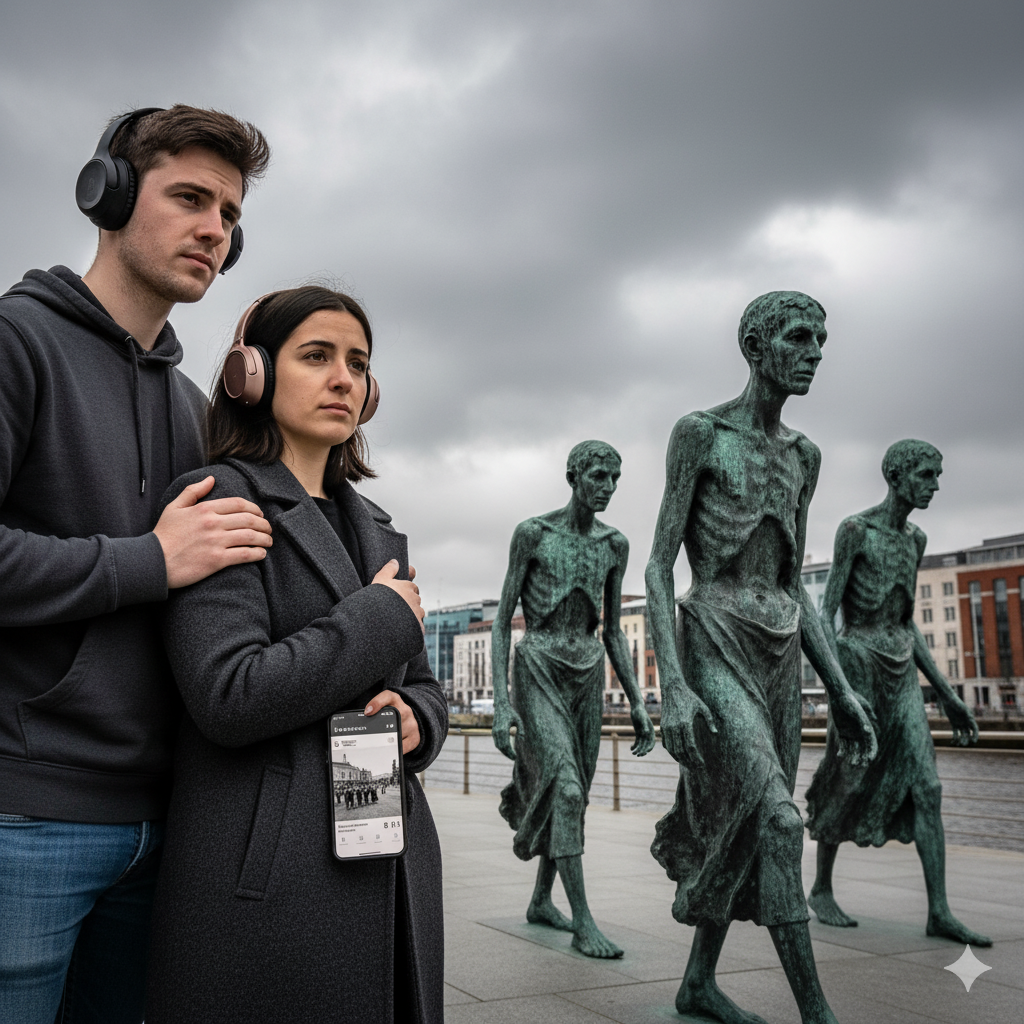
Witness Ireland's most powerful memorial, where haunting bronze figures capture the desperation and dignity of those who fled starvation during the Great Hunger of the 1840s. Your audio guide reveals the heartbreaking statistics behind this national tragedy, sharing the impossible choices families faced between staying and starving or leaving everything behind. Discover the artist's careful research and emotional process in creating these deeply moving figures.
Cross Dublin's most elegant modern bridge, where Spanish architect Santiago Calatrava created a harp-shaped masterpiece that celebrates Ireland's musical heritage alongside 21st-century engineering brilliance. Your audio guide reveals the complex design process behind this graceful structure, sharing stories of construction challenges and the innovative solutions that brought this artistic vision to life. Discover the bridge's rotating mechanism that opens for tall ships.
Honour Ireland's struggle for independence in this sacred space where reflection pools and symbolic sculptures commemorate those who gave their lives for freedom. Your audio guide reveals the garden's powerful symbolism, from the cross-shaped pool representing purification to the sculpture depicting the Children of Lir transforming into swans. Discover the historical significance of this location, where the Irish Volunteers were founded.
Wander through Ireland's premier botanical wonderland, where 19th-century glasshouses shelter exotic treasures while native plants showcase the remarkable diversity of Irish flora. Your audio guide reveals scientific discoveries made within these gardens, sharing stories of the plant hunters who risked everything to bring rare specimens back to Dublin. Discover the architectural marvels of the Victorian conservatories and learn about medicinal plants that changed medicine.
Explore Europe's largest enclosed park, where 1,750 acres of rolling grassland, ancient trees, and roaming deer create an urban wilderness that has served as Dublin's playground for over 350 years. Your audio guide reveals the park's transformation from royal hunting ground to public treasure, sharing stories of duels, political rallies, and papal visits. Discover hidden monuments scattered throughout the landscape and the wild deer that have called this park home for centuries.
Included & Not Included
Know exactly what you're getting before you buy.
- 23 premium SoundCloud streaming audio guides
- Interactive Google My Maps (all 23 locations)
- Suggested walking routes & navigation tips
- Complete step-by-step tour instructions
- Insider tips & best-time-to-visit advice
- 6-day unlimited replay access
- Historical context & cultural background
- 24/7 technical support (email & WhatsApp)
- 12 language options (select at purchase)
- Instant email delivery upon purchase
- Museum & church admission fees (buy separately)
- Transportation between attractions
- Mobile device & internet connection
- Headphones / earbuds
- Food, beverages & personal expenses
- Travel insurance
- Accommodation
- Human / live tour guide
- Downloadable (offline) audio files
- GPS navigation system
How to Use Your Dublin Audio Tour
Six simple steps for the perfect self-guided experience.
-
1Download Your PDF Guide
Immediately after purchase, check your email for the download link. Save the PDF to your smartphone, tablet, or computer. Review the contents and familiarise yourself with the map and attraction list.
-
2Plan Your Route
Review the interactive Google My Maps showing all 23 attraction locations. Decide which attractions you want to visit and check opening hours — St. Michan's Church and Chester Beatty both have limited visiting windows, so plan those stops earlier in the day.
-
3Prepare Your Device
Charge your smartphone fully and bring a portable power bank. Verify you have reliable mobile data or Wi-Fi, test your headphones, and download Google Maps for navigation between stops.
-
4Start Your Tour
Navigate to your first attraction using the provided map. Open your PDF, click the SoundCloud link for that stop, press play, and begin listening while you explore. Pause anytime to take photos or read information plaques.
-
5Explore at Your Own Pace
Listen to the full audio or skip sections as you wish. Visit attractions in any order, take breaks whenever you like, and spend as much or as little time as you want at each location. This is Dublin on your terms.
-
6Continue Throughout Your Visit
Your audio guides remain accessible for up to 6 days from first activation. Return to previously visited sites, use guides across multiple days, and revisit favourites as often as you wish within the access window.
The 10 Uvamai "S" Advantages
Why independent travellers choose Uvamai over every other Dublin option.
| Advantage | Uvamai Dublin | Traditional Group Tour | Private Guided Tour |
|---|---|---|---|
| 🕐 Self-Paced | ✅ Explore anytime, any order | ❌ Fixed schedule, group pace | ⚠️ Flexible, but tied to your guide's schedule |
| 💰 Smart Price | ✅ From $6 — unbeatable value for 23 attractions | ❌ €25–€60+ per person | ❌ €150–€400+ per group, often hourly |
| 📖 Stories | ✅ Deep dives most miss — like why 800-year-old mummies still rest beneath St. Michan's Church | ⚠️ Quality varies by guide | ✅ Personalised, expert-led |
| 🕵️ Secret Dublin | ✅ 23 sites across Dublin, from hidden Iveagh Gardens to the Famine Sculptures on the quays | ❌ Curated, well-trodden stops only | ⚠️ Customisable, but fewer stops per session |
| ✨ Spontaneity | ✅ Skip St. Teresa's one day, linger in Phoenix Park's deer trails the next | ❌ No detours allowed | ✅ Can adjust route with your guide |
| 🧍 Solo-Friendly | ✅ Perfect for solo travellers | ❌ Designed for groups | ❌ Expensive for a single traveller |
| 🛟 Support | ✅ 24/7 email & WhatsApp | ❌ No support once tour ends | ⚠️ Support only during your booked session |
| 🎧 Sound Quality | ✅ Professionally recorded, crystal-clear narration | ⚠️ Street noise often an issue | ⚠️ Live voice, still affected by street noise |
| 🔇 Silent Mode | ✅ Pause & use in silence — ideal inside St. Ann's Church | ❌ Must keep up with group | ❌ Conversation-based, no silent option |
| ⚡ Simple | ✅ No app, no account, no booking hassle — just click and go | ❌ Fixed meeting point and check-in | ⚠️ Requires booking and coordination |
Available Languages
Select your language at purchase — this choice is final and cannot be changed after your order is complete.
⚠️ Language selection is made during checkout and is FINAL. Once your purchase is complete, the language version cannot be exchanged, changed, or refunded. Double-check your selection before completing payment.
Dublin Travel Tips
Insider advice to make the most of your Dublin visit.
May–September for mild weather and long daylight hours. Shoulder months like April and October offer smaller crowds. Visiting for St. Patrick's Day (17 March)? Book everything well ahead — the city fills up fast.
Dublin's city centre is wonderfully walkable. The Luas tram and Dublin Bus cover longer distances cheaply — get a Leap Card to save on fares. Taxis and rideshares are available but pricier during rush hour.
Dublin is largely cashless — cards are accepted almost everywhere, including small purchases. Keep a little cash on hand for market stalls or traditional pubs that still prefer it.
Bring a waterproof jacket year-round — rain is possible any month. Wear comfortable, waterproof shoes for the cobblestones near St. Audoen's and the Liberties. Layers are essential as temperatures shift through the day.
Irish pubs are social spaces — rounds are a cultural institution, so expect to take your turn if you join a group. Queuing is taken seriously, and a friendly greeting goes a long way with locals.
Try a traditional Irish breakfast, fresh seafood chowder, and a properly poured pint of Guinness. Tap water is safe and excellent throughout the city. Traditional, locals-first pubs often serve the best value food.
Refund Policy — All Sales Are Final
This digital product has a strict no-refund policy. All sales are final and non-refundable. This policy applies regardless of:
- Changed travel plans or cancelled trips
- Technical issues on your end (device, internet)
- Dissatisfaction with content or narration style
- Selecting the wrong language at purchase
- Forgetting to use the product during the access period
- Medical emergencies or personal circumstances
- Weather conditions or attraction closures
- Finding free alternatives after purchase
- Any other reason whatsoever
This is a digital download delivered instantly. Once you receive the PDF, you have immediate access to the complete product. Digital products cannot be returned. While refunds are not possible, we provide 24/7 technical support for all access issues.
⚠️ If you have ANY doubts, contact us BEFORE purchasing.
Frequently Asked Questions
Quick answers before you buy.
This tour is $6 USD per person. If your group is happy sharing one phone or set of headphones, one purchase covers that. If more than one traveller wants the tour open on their own device, each person needs their own $6 purchase.
The $6 price is per person, not per group. For a group of 3 or 4 each listening independently on their own phone, that's $18–$24 total — one purchase is only enough if everyone shares a single device together.
No. Everything runs through your browser — audio streams via SoundCloud links and the route opens in Google My Maps. No app to install.
Your 6-day access window starts the moment you click your first audio link, not at purchase. All sales are final with no refunds, so plan your visit to fit within that window.
No — your language selection is locked in at checkout and cannot be changed or exchanged afterward.
Final Checklist Before Purchase
Reach us before or during your Dublin tour — any hour, any day.
Purchase now — activate only when you're ready to explore. Your 6-day access begins on your first audio guide click, not at purchase.
❓ Unsure about anything? Contact us at tours@uvamai.com or WhatsApp +91 7598234240 BEFORE buying. Once payment is complete, it cannot be reversed.
tours@uvamai.com · +91 7598234240 · uvamai.com · Since 2012, Crafted with Care
Share


Why Uvamai?
Trusted by 13,996+ explorers since 2012. Ethical, story-driven travel built for independent travellers who want depth over checklists.