


Uvamai Niche Tourism
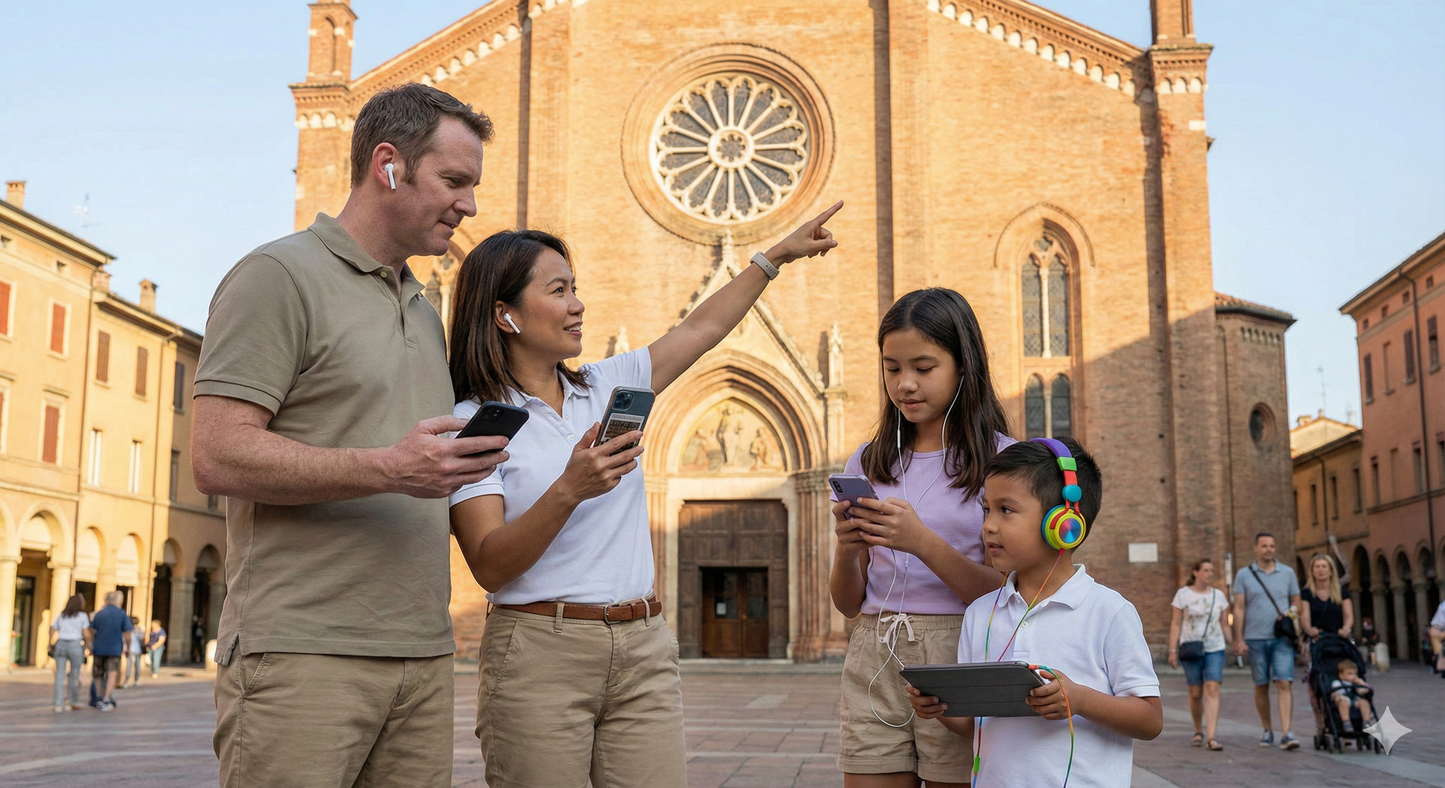
Bologna Self-Guided Audio Tour
Bologna Self-Guided Audio Tour
Não foi possível carregar a disponibilidade de retirada.
Bologna Self-Guided
Audio Tour
La Dotta, La Grassa, La Rossa · Italy's Original University City
18 expertly narrated audio guides · Historic churches, grand piazzas & UNESCO-listed porticoes · Explore at your own pace · From $6 per person
⚡ Instant Digital Download · 12 Languages · 6-Day AccessExperience Bologna like never before with our comprehensive self-guided audio tour featuring 18 expertly narrated audio guides covering the city's grandest piazzas, hidden Renaissance treasures, and UNESCO-listed porticoes. This digital download includes instant access to professionally produced audio commentaries, an interactive map, and complete walking instructions that let you explore Bologna at your own pace.
From the Art Deco grandeur of Stazione Centrale to the unfinished ambition of the Basilica di San Petronio, from Giambologna's audacious Neptune Fountain to the hidden fresco cycles inside the Oratorio di Santa Cecilia — every audio guide reveals fascinating stories, historical insights, and exclusive details that bring Bologna's scholarly, artistic, and deliciously food-obsessed character to life. Perfect for independent travellers who value flexibility, authenticity, and expert knowledge without the constraints of group tours.
What Is This Product?
A digital PDF delivered instantly to your email — containing everything you need for an exceptional self-guided audio tour of Bologna.
- PDF with 18 SoundCloud streaming links
- Interactive Google My Maps
- Walking routes & navigation tips
- 6-day unlimited access
- 12 language options
- 24/7 technical support
- NOT a physical product
- NOT a live guided tour
- NOT downloadable audio files
- NOT museum admission tickets
- NOT transport included
- NOT a GPS navigation system
18 Attractions with Audio Guides
Every stop comes with expert narration revealing history, hidden details, and stories most visitors never hear. Audio durations shown are approximate — actual length may vary slightly depending on your selected language.
This soaring Art Deco station is more than a transit point — it's where journeys into Bologna's soul truly begin. Rebuilt after WWII bombing raids that could have destroyed it entirely, its restoration remains a quiet symbol of the city's resilience. Beneath the platforms, wartime tunnels once sheltered residents during air raids, a history most travellers pass over without a second glance. Your guide traces the station's evolution from grand 19th-century gateway to modern transport hub, and explains why this is the perfect first stop before diving into Bologna's older, red-brick heart.
Bologna's grandest boulevard carries a patriotic name earned during the fight for Italian unification, and its wide porticoed pavements have witnessed protest, romance, and revolution in equal measure. Behind stately palazzo façades lie hidden courtyards that most visitors walk straight past, each with its own quiet history. Your narration traces the resistance networks that once operated beneath these very streets during the Nazi occupation, and points out architectural details easy to miss at street level. Discover why this thoroughfare functions as far more than a shopping street — it's a spine connecting centuries of Bolognese ambition.
Bologna's cathedral has been rebuilt more than once, most dramatically after a catastrophic collapse in 1599 that forced a near-total reconstruction. Inside, a baroque interior conceals a revered crucifix wrapped in local legend, alongside decorative symbolism that rewards close attention. Your guide explains the cathedral's complicated relationship with papal authority over the centuries, and the older passageways once said to connect it to nearby religious sites. Discover how this working cathedral remains a genuine spiritual anchor for the city, quieter and less visited than Bologna's more famous basilicas.
Locals call this Bologna's "living room" — a library built quite literally on top of Roman history, with ancient street foundations visible beneath a glass floor. Your narration traces its transformation from Roman settlement to Fascist-era stock exchange to today's open, light-filled cultural hub. Learn how architects balanced the preservation of archaeological layers with the demands of a thoroughly modern public space, and why the building's earlier incarnations still shape how Bolognese use it today. Discover a rare civic project where centuries of history and contemporary life sit comfortably under one roof.
Behind this Gothic palazzo's imposing walls lies one of medieval Europe's strangest captivities: King Enzo of Sardinia, held here for over two decades yet treated with surprising deference by his Bolognese captors. Your guide unpacks the Guelf–Ghibelline conflicts that made this building strategically vital, and the architectural features designed for both grandeur and control. Discover how Enzo's long imprisonment became woven into local folklore, blurring the line between prisoner and reluctant civic celebrity. Learn why this palace remains one of the clearest windows into Bologna's turbulent medieval power struggles.
Giambologna's bronze Neptune towers over Bologna with a swagger that scandalised city censors long before it delighted the public — earning the nickname "Il Gigante" from locals. Your narration reveals the artistic compromises the sculptor made to satisfy the Church without sacrificing his vision, and the fountain's lesser-known role in the city's historic water supply. Discover the symbolic details worked into Neptune's pose and companions, each carrying meaning for those who know where to look. Learn why this Renaissance masterpiece still feels like an act of quiet defiance frozen in bronze.
Few squares in Europe balance ecclesiastical, civic, and noble power as elegantly as Piazza Maggiore, where centuries of Bolognese ambition play out across a single harmonious space. Your guide traces how each surrounding building represents a different era and authority, yet together they form what Napoleon reportedly called "the drawing room of Europe." Learn about the square's darker history as a stage for public executions alongside its role in celebration and civic life. Discover the architectural details and rivalries behind the buildings that frame this space, and why it remains Bologna's undisputed beating heart.
Conceived to rival St Peter's in Rome, this vast Gothic basilica was deliberately checked by papal interference — leaving its façade permanently, famously unfinished. Inside, astronomer Cassini's meridian line stretches across the floor, once among the most precise scientific instruments of its age. Your narration explains the political tensions that shaped the building's fate, and points out frescoes whose geographic accuracy once unsettled Church authorities. Discover why an unfinished cathedral tells a far richer story than a completed one ever could.
For eight centuries this palazzo has served as Bologna's seat of governance, surviving wars, uprisings, and shifting political tides. Your guide leads you through halls where crucial civic decisions were made, and frescoed chambers that quietly narrate the city's long history of self-rule. Discover the artistic treasures that survived successive upheavals, and the stories of leaders who governed from these very rooms. Learn how Bologna's distinctive medieval republicanism, shaped within these walls, influenced governance models well beyond the city's borders.
Few artworks in Italy carry the emotional force of the Lamentation over the Dead Christ, a haunting terracotta group housed within this sanctuary. Your narration explores the mystery surrounding sculptor Niccolò dell'Arca, whose techniques brought raw human grief to stone with startling realism. Learn about the confraternity traditions and charitable works once carried out from within these walls, quietly shaping Bolognese social life for centuries. Discover why art historians consider this sculptural group one of the most moving achievements of the entire Renaissance period.
Bologna's covered porticoes represent a uniquely medieval solution to an urban housing shortage, eventually stretching to some 40 kilometres of sheltered walkways across the city. Your guide explains the architectural regulations that kept centuries of construction in visual harmony, and the social life — commerce, courtship, conversation — that has always flourished beneath these arches. Discover why UNESCO recognised the porticoes as world heritage in 2021, and how this stretch near Piazza Maggiore remains one of the liveliest. Learn how a purely practical medieval solution became one of Italy's most distinctive architectural signatures.
Behind a deceptively modest façade lies the spiritual and intellectual heart of the Dominican order, home to the tomb of St Dominic himself, adorned with early contributions attributed to a young Michelangelo. Your narration traces the basilica's central role in medieval theological education, and the scholarly community whose ideas rippled outward across Christian Europe. Discover the stories of the saints, scholars, and reformers connected to this understated but historically pivotal church. Learn why San Domenico's influence on Christian thought far outweighs its unassuming exterior.
Locals call this atmospheric square Bologna's "Jerusalem" — home to a complex of interconnected churches that medieval monks built to echo the sacred sites of the Holy Land. Your guide unpacks the mysterious polygonal Church of the Holy Sepulchre and an ancient baptistery whose origins predate Christianity in Bologna altogether. Discover the legends surrounding the courtyard's bronze basin, and the centuries of pilgrimage that have passed through this space. Learn how this compact complex recreates an entire sacred landscape within a single Bolognese piazza.
Step deeper into the Santo Stefano complex to uncover Romanesque treasures and crypts said to house the remains of early martyr saints. Your narration explains the symbolic architecture designed to echo Christ's Passion, and the remarkable building techniques that have preserved these interconnected structures for over a thousand years. Discover the artistic patronage behind the complex's decoration, and its enduring role in Bolognese spiritual life. Learn why this labyrinthine sanctuary is considered one of Europe's most ambitious religious building projects, offering a pilgrimage experience without ever leaving the city.
This Gothic basilica helped transform religious architecture in medieval Italy, its soaring interior built to lift the eye and spirit alike. Your guide reveals the miraculous icon of the Madonna that has drawn pilgrims here for centuries, alongside frescoes shaped by the devoted Servite order. Discover the noble patrons and artistic rivalries that shaped the basilica's development over generations. Learn how Santa Maria dei Servi blends northern Gothic influence with distinctly Italian sensibility, producing a uniquely Bolognese expression of faith.
Inside this elegant Renaissance church, the Bentivoglio family chapel bursts with frescoes by Francia and Costa, chronicling one of Bologna's most powerful ruling dynasties. Your narration traces the political ambition and artistic patronage behind this concentration of Renaissance masterpieces. Discover the musical traditions once nurtured within these walls, and the composers who drew inspiration from this space. Learn how San Giacomo Maggiore captures Renaissance Bologna at its most confident and artistically ambitious.
This intimate oratory holds one of Italy's most complete Renaissance fresco cycles, commissioned as the Bentivoglio family's private devotional space. Your guide walks you through the painted scenes narrating the story of Saints Cecilia and Valerian, and the symbolic details embedded for informed viewers of the time. Discover the preservation efforts that rescued these luminous frescoes from destruction over the centuries. Learn how this small, easily overlooked space concentrates an extraordinary amount of Renaissance artistic achievement into a single perfectly preserved room.
Among Italy's earliest Franciscan churches, this soaring basilica holds the tomb of Pope Alexander V alongside altarpieces by celebrated Bolognese masters. Your narration traces the basilica's direct connection to St Francis of Assisi and the reform movement that reshaped medieval Christianity. Discover the architectural ambition behind its towering nave, unusual for its era, and the religious significance that drew scholars and pilgrims alike. Learn how San Francesco helped establish Bologna as a genuine centre of medieval Christian learning and spiritual reform.
Included & Not Included
Know exactly what you're getting before you buy.
- 18 premium SoundCloud streaming audio guides
- Interactive Google My Maps (all 18 locations)
- Suggested walking routes & navigation tips
- Complete step-by-step tour instructions
- Insider tips & best-time-to-visit advice
- 6-day unlimited replay access
- Historical context & cultural background
- 24/7 technical support (email & WhatsApp)
- 12 language options (select at purchase)
- Instant email delivery upon purchase
- Museum admission tickets (buy separately)
- Transportation between attractions
- Mobile device & internet connection
- Headphones / earbuds
- Food, beverages & personal expenses
- Travel insurance
- Accommodation
- Human / live tour guide
- Downloadable (offline) audio files
- GPS navigation system
How to Use Your Bologna Audio Tour
Six simple steps for the perfect self-guided experience.
-
1Download Your PDF Guide
Immediately after purchase, check your email for the download link. Save the PDF to your smartphone, tablet, or computer. Review the contents and familiarise yourself with the map and attraction list.
-
2Plan Your Route
Review the interactive Google My Maps showing all 18 attraction locations. Decide which attractions you want to visit and check opening hours. Many of Bologna's churches close for a few hours at midday and expect modest dress — shoulders and knees covered — so plan your route accordingly.
-
3Prepare Your Device
Charge your smartphone fully and bring a portable power bank. Verify you have reliable mobile data or Wi-Fi, test your headphones, and download Google Maps for navigation between stops.
-
4Start Your Tour
Navigate to your first attraction using the provided map. Open your PDF, click the SoundCloud link for that stop, press play, and begin listening while you explore. Pause anytime to take photos or read information plaques.
-
5Explore at Your Own Pace
Listen to the full audio or skip sections as you wish. Visit attractions in any order, take breaks whenever you like, and spend as much or as little time as you want at each location. This is Bologna on your terms.
-
6Continue Throughout Your Visit
Your audio guides remain accessible for up to 6 days from first activation. Return to previously visited sites, use guides across multiple days, and revisit favourites as often as you wish within the access window.
The 10 Uvamai "S" Advantages
Why independent travellers choose Uvamai over every other Bologna option.
| Advantage | Uvamai Bologna | Traditional Group Tour | Private Guided Tour |
|---|---|---|---|
| 🕐 Self-Paced | ✅ Linger in Piazza Maggiore, revisit Santo Stefano when the crowds thin | ❌ Fixed schedule, group pace | ⚠️ Flexible, but tied to your guide's schedule |
| 💰 Smart Price | ✅ From $6 — unbeatable value | ❌ $35–$65+ per person | ❌ $150–$400+ per group, often hourly |
| 📖 Stories | ✅ Deep dives most miss — like why San Petronio's façade was left unfinished | ⚠️ Quality varies by guide | ✅ Personalised, expert-led |
| 🏛️ Streets & Porticoes | ✅ 18 sites across Bologna's UNESCO-listed porticoes | ❌ Curated stops only | ⚠️ Customisable, but fewer stops per session |
| ✨ Spontaneity | ✅ Detour into San Giacomo Maggiore one moment, linger at Fontana del Nettuno the next | ❌ No detours allowed | ✅ Can adjust route with your guide |
| 🧍 Solo-Friendly | ✅ Perfect for solo travellers | ❌ Designed for groups | ❌ Expensive for a single traveller |
| 🛟 Support | ✅ 24/7 email & WhatsApp | ❌ No support once tour ends | ⚠️ Support only during your booked session |
| 🎧 Sound Quality | ✅ Professionally recorded narration, crisp and clear | ⚠️ Street noise often an issue | ⚠️ Live voice, still affected by street noise |
| 🔇 Silent Mode | ✅ Pause & use in silence | ❌ Must keep up with group | ❌ Conversation-based, no silent option |
| ⚡ Simple | ✅ No app, no account, no booking hassle — just click and go | ❌ Fixed meeting point and check-in | ⚠️ Requires booking and coordination |
Available Languages
Select your language at purchase — this choice is final and cannot be changed after your order is complete.
⚠️ Language selection is made during checkout and is FINAL. Once your purchase is complete, the language version cannot be exchanged, changed, or refunded. Double-check your selection before completing payment.
Bologna Travel Tips
Insider advice to make the most of your Bologna visit.
April–June and September–October for pleasant weather and thinner crowds. Avoid August, when many local restaurants and shops close for the summer break.
The historic centre is compact and entirely walkable, sheltered almost everywhere by covered porticoes. Bicycles are widely available to rent for longer trips beyond the centre.
Most cafés, shops, and museums accept cards, though small family-run trattorias may prefer cash. ATMs are common throughout the centre near Piazza Maggiore.
Summers are hot and humid, winters cold with occasional snow. Bring an umbrella in spring and comfortable shoes for cobblestones — the porticoes offer shelter but streets can still be slippery when wet.
Never call it "spaghetti bolognese" — locals serve ragù with tagliatelle or in lasagna, never spaghetti. Greet shopkeepers with a friendly "buongiorno" before browsing; it's considered good manners.
Try tortellini in brodo, Bologna's famous mortadella, and a glass of Pignoletto from the surrounding hills. Tap water is safe and free at public fountains throughout the city.
Refund Policy — All Sales Are Final
This digital product has a strict no-refund policy. All sales are final and non-refundable. This policy applies regardless of:
- Changed travel plans or cancelled trips
- Technical issues on your end (device, internet)
- Dissatisfaction with content or narration style
- Selecting the wrong language at purchase
- Forgetting to use the product during the access period
- Medical emergencies or personal circumstances
- Weather conditions or attraction closures
- Finding free alternatives after purchase
- Any other reason whatsoever
This is a digital download delivered instantly. Once you receive the PDF, you have immediate access to the complete product. Digital products cannot be returned. While refunds are not possible, we provide 24/7 technical support for all access issues.
⚠️ If you have ANY doubts, contact us BEFORE purchasing.
Frequently Asked Questions
Quick answers before you buy.
This tour is $6 USD per person. If your group is happy sharing one phone or set of headphones, one purchase covers that. If more than one traveller wants the tour open on their own device, each person needs their own $6 purchase.
The $6 price is per person, not per group. For a group of 3 or 4 each listening independently on their own phone, that's $18–$24 total — one purchase is only enough if everyone shares a single device together.
No. Everything runs through your browser — audio streams via SoundCloud links and the route opens in Google My Maps. No app to install.
Your 6-day access window starts the moment you click your first audio link, not at purchase. All sales are final with no refunds, so plan your visit to fit within that window.
No — your language selection is locked in at checkout and cannot be changed or exchanged afterward.
Final Checklist Before Purchase
Reach us before or during your Bologna tour — any hour, any day.
Purchase now — activate only when you're ready to explore. Your 6-day access begins on your first audio guide click, not at purchase.
❓ Unsure about anything? Contact us at tours@uvamai.com or WhatsApp +91 7598234240 BEFORE buying. Once payment is complete, it cannot be reversed.
tours@uvamai.com · +91 7598234240 · uvamai.com · Since 2012, Crafted with Care
Share


Why Uvamai?
Trusted by 13,996+ explorers since 2012. Ethical, story-driven travel built for independent travellers who want depth over checklists.