


Uvamai Niche Tourism
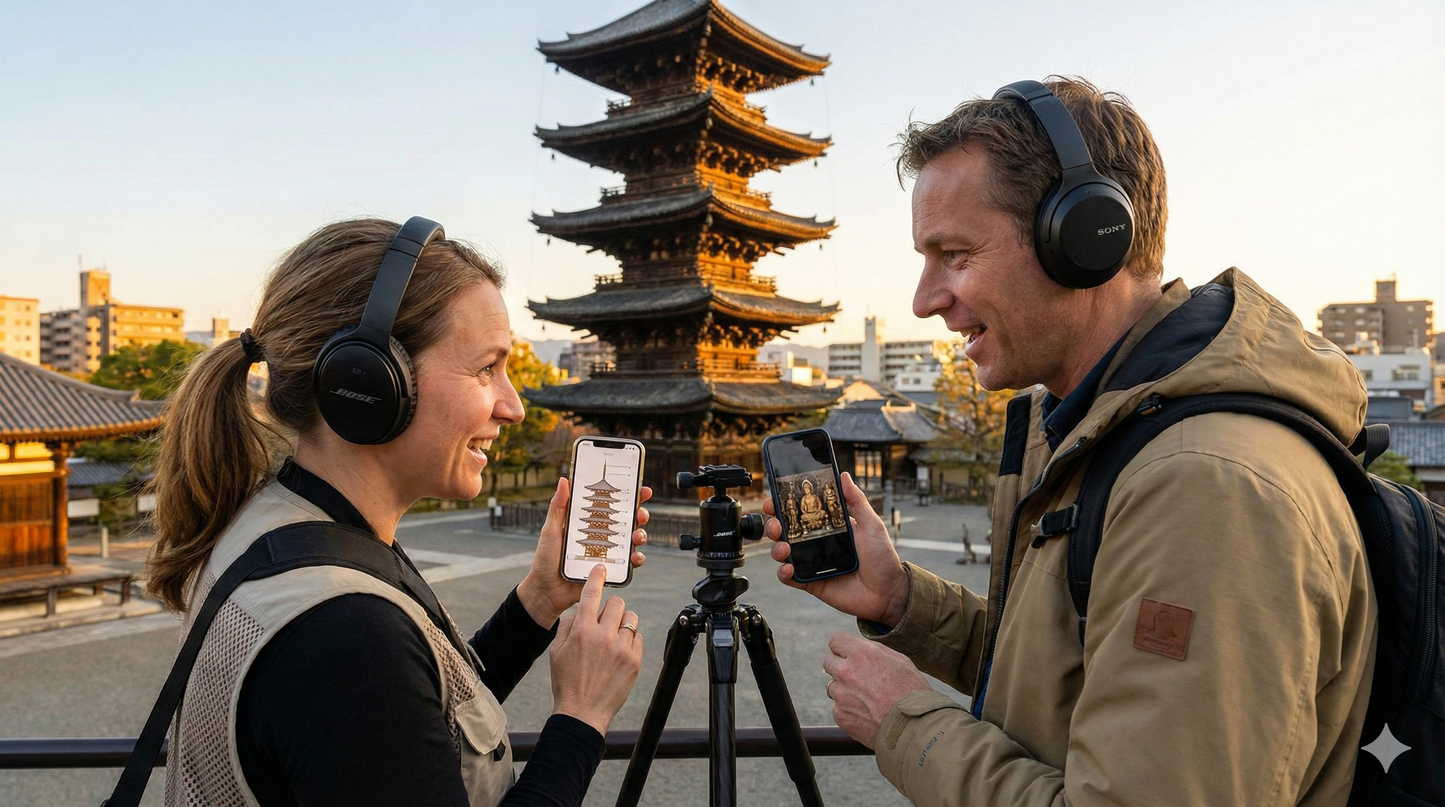
Kyoto Self-Guided Audio Tour
Kyoto Self-Guided Audio Tour
Không thể tải khả năng nhận hàng tại cửa hàng
Kyoto Self-Guided
Audio Tour
City of Ten Thousand Shrines · Japan's Ancient Capital
23 expertly narrated audio guides · Temples, shrines & imperial gardens · Explore at your own pace · From $6 per person
⚡ Instant Digital Download · 12 Languages · 6-Day AccessExperience Kyoto like never before with our comprehensive self-guided audio tour featuring 23 expertly narrated audio guides covering Japan's ancient capital — its grandest temples, its oldest shrines, and the quiet corners most visitors rush straight past. This digital download includes instant access to professionally produced audio commentaries, an interactive map, and complete guidance that let you explore Kyoto entirely at your own pace.
From the shimmering Kinkaku-ji and the endless vermilion gates of Fushimi Inari-taisha to the raked gravel of Ryoan-ji's rock garden and the bamboo groves of Arashiyama — every audio guide uncovers the history, religious symbolism, and human stories behind Kyoto's most treasured sites. Perfect for independent travellers who want depth and context without the constraints of a scheduled group tour.
What Is This Product?
A digital PDF delivered instantly to your email — containing everything you need for an exceptional self-guided audio tour of Kyoto.
- PDF with 23 SoundCloud streaming links
- Interactive Google My Maps
- Routes & navigation tips
- 6-day unlimited access
- 12 language options
- 24/7 technical support
- NOT a physical product
- NOT a live guided tour
- NOT downloadable audio files
- NOT temple or shrine admission tickets
- NOT transport included
- NOT a GPS navigation system
23 Attractions with Audio Guides
Every stop comes with expert narration revealing history, religious symbolism, and stories most visitors never hear. Audio durations shown are approximate — actual length may vary slightly depending on your selected language.
Step into the striking steel-and-glass gateway to the ancient capital, a building designed to bridge Kyoto's imperial past and its modern identity. Your audio guide unpacks the architectural symbolism woven through its soaring atrium, exposed beams, and rooftop sky garden, and revisits the fierce public debate that greeted its construction. Discover why locals were divided over a design this bold in a city famous for restraint, and how the station has since become a landmark in its own right. Small architectural details throughout the concourse are said to quietly reference the city's 1,200-year history — details even frequent visitors miss entirely.
Stand before one of Japan's largest wooden structures, headquarters of the Shinshū Ōtani-ha school of Jōdo Shinshū Buddhism, built amid rivalry with its sister temple across the city. Your audio guide tells the extraordinary story of devotees who donated their own hair to weave the giant ropes used to hoist the temple's massive pillars into place. Learn how the complex was rebuilt after devastating fires, and what its towering Goei-dō Main Hall represents in the practice of Japanese Buddhist devotion. This is a story of collective sacrifice on a scale most visitors never expect from a single building.
Pass beneath thousands of vermilion torii gates tunnelling up the mountainside, each one donated by an individual or business seeking the favour of Inari, the Shinto deity of rice and prosperity. Your audio guide explains the symbolism of the fox guardians watching over the shrine, decodes the inscriptions written on gate after gate, and points you toward the quieter upper trails where most tour groups never venture. Discover the rituals still performed here by local merchants today, and why continuing past the first viewpoint rewards you with a completely different experience. Few sites in Japan reward patience and curiosity the way this one does.
Explore a sprawling Zen Buddhist complex built to rival the great temples of Nara, Todai-ji and Kofuku-ji, whose names it combines. Your audio guide reveals the philosophy behind the four gardens surrounding its Hojo hall, designed by Shigemori Mirei in 1939. Discover the famous Tsutenkyo Bridge spanning a maple-filled valley, and where to stand to see the maple canopy at its most dramatic. This is one of the finest places in Kyoto to understand how Zen gardens are meant to be read, not just admired.
Enter an extraordinarily long wooden hall lined with 1,001 statues of Kannon, the goddess of mercy — 1,000 life-sized standing figures around a large seated main image, each one subtly distinct despite an almost identical appearance. Your audio guide explains the 28 guardian deities that stand watch over the figures, drawing on both Hindu and Buddhist tradition, and recounts how the hall, rebuilt after a fire in 1249, has survived the centuries since. Discover the archery contests once held along its long verandah, and the remarkable craftsmanship that allowed these statues to be carved with such consistency at scale. There is nowhere else in the world quite like this room.
Marvel at a UNESCO World Heritage temple built dramatically into a hillside, its famous wooden stage extending over the valley without a single nail holding it together. Your audio guide traces the sacred spring that gives the temple its name, "Pure Water Temple," and explains the romantic ritual at the Jishu Shrine within its grounds, where visitors cross between two stones with their eyes closed to test their fate in love. Learn about the daring Edo-period tradition of leaping from the stage in hope of a granted wish, and the meaning behind the temple's vivid three-storied pagoda. This site has drawn pilgrims for more than 1,200 years.
Wander two sloping stone-paved streets where modern Kyoto quietly gives way to the atmosphere of the Edo period. Your audio guide shares the old superstitions attached to these lanes — "Three-Year Slope" and "Two-Year Slope" — including why locals are careful never to stumble on the steps. Discover the history of the wooden machiya townhouses that line the way, many now repurposed as shops and teahouses while keeping their original character intact. Your narrator also points you toward quieter side lanes where authentic local life still continues away from the main flow of visitors.
Discover the deeply personal history behind this elegant temple, founded by Nene, widow of the powerful warlord Toyotomi Hideyoshi, as a lifelong tribute to her husband. Your audio guide explains the symbolism built into its gardens, said to be the work of the celebrated landscape architect Kobori Enshu, including its "Moon Viewing Pavilion". Learn about the temple's exquisite gold-and-silver maki-e lacquerware, among the finest in Japan, and the quiet meaning held within its bamboo grove. Few temples in Kyoto carry a love story this vivid.
Visit Kyoto's oldest Zen temple, founded in 1202 by the monk Eisai, who is credited with introducing both formal Zen practice and tea cultivation to Japan after years of study in China. Your audio guide explains how to read the temple's famous twin dragons ceiling painting, completed in 2002 for its 800th anniversary, and reveals the design details built to support meditation throughout the grounds. Learn the best vantage points for appreciating its rock gardens, and the meaning behind their seemingly simple stone arrangements. Two of Japan's most enduring cultural traditions trace their roots to this temple's founder.
Explore a vast Zen Buddhist complex that began life as an imperial villa before its conversion into a temple in the 13th century. Your audio guide explains the imposing Sanmon gate, built to commemorate soldiers who died ending Japan's Warring States period, and unpacks the surprising story of the temple's brick aqueduct — a Meiji-era relic that creates an unexpected clash of Western engineering and traditional design. Discover how to read the enigmatic Hojo garden from several different angles, and which quiet sub-temples most visitors pass straight by. History here layers imperial, military, and industrial Japan in a single site.
Discover the touching legend behind the temple's unique "Looking-Back Buddha" statue, shown glancing over its shoulder as a gesture of compassion for those who are slow to find enlightenment. Your audio guide traces the temple's origins as a place of healing, and explains how its grounds shift in mood with the seasons — most dramatically in autumn, when the grounds blaze with colour. Let your narrator guide you to the hidden Tahoto Pagoda for one of the finest panoramic views in Kyoto. This is Pure Land Buddhism expressed through architecture and patience.
Visit a relatively young shrine, built in 1895 to mark Kyoto's 1,100th anniversary as Japan's capital, constructed as a partial replica of the original Heian Palace. Your audio guide explains its dedication to Emperor Kammu and Emperor Komei — the first and last emperors to rule from Kyoto — and what this symbolised during a period of rapid national modernisation. Discover the gardens designed by the celebrated landscape architect Ogawa Jihei, arranged into four gardens, each influenced by a different period of history, and learn how the shrine's Jidai Matsuri festival recreates a thousand years of Kyoto's history in a single annual procession. It offers a rare glimpse of an imperial layout that no longer physically exists.
Learn why shogun Ashikaga Yoshimasa's famous "Silver Pavilion" was never actually covered in silver, and how that unfinished quality came to embody the Japanese aesthetic of wabi-sabi — beauty found in imperfection. Your audio guide traces the site's role as the centre of Higashiyama culture, which shaped the tea ceremony and ikebana flower arrangement during a golden age of Japanese culture. Discover how to properly appreciate its extraordinary dry sand garden, "The Sea of Silver Sand," including the meaning behind its meticulously shaped sand cone. Your narrator explains how the entire site was designed as a slow journey meant to sharpen the visitor's attention.
Step into one of Kyoto's oldest Shinto shrines, a UNESCO World Heritage site established even before Kyoto became Japan's capital in 794 CE, strategically positioned where the Kamo and Takano rivers meet. Your audio guide explains the shrine's ancient role in water purification rituals and its historic function protecting the city from malevolent forces. Discover the sacred Tadasu no Mori forest surrounding the shrine, one of the last old-growth forests remaining in Kyoto, and the centuries-old trees venerated within it. Learn the symbolism behind the annual Aoi Matsuri, one of the city's most significant traditional festivals.
Explore the former seat of Japan's imperial power, home to emperors until the capital moved to Tokyo in 1869. Your audio guide explains how the arrangement of its many structures reflected strict court hierarchy and elaborate ceremonial requirements, and how its 1855 rebuilding deliberately revived Heian-period architecture to emphasise the imperial family's ancient lineage. Discover the court ceremonies once performed within these grounds, and the meaning behind decorative elements that appear austere at first glance. Your narrator brings quiet, formal buildings to life with the human drama of centuries of imperial rule.
Discover the ingenious defensive design of this UNESCO World Heritage castle, built by Tokugawa Ieyasu as a statement of shogunal power, including its famous "nightingale floors", said to have been engineered to chirp underfoot as an early warning system against assassins — and they still chirp today. Your audio guide decodes the political symbolism painted into the castle's elaborate screens, subtle messages meant to remind visiting feudal lords of the shogun's power. Learn how the castle witnessed the height of samurai rule and its dramatic end, when the last shogun relinquished power within these very walls in 1867. Every room here was built to communicate status without a single word.
Visit the shrine dedicated to Sugawara no Michizane, a 9th-century scholar and politician deified after his death, whose story of exile and eventual vindication made this a powerful symbol of scholarship and justice. Your audio guide explains why students still visit before exams, and why the shrine's plum trees carry special meaning connected to legends about the deity's poetic gifts. Discover the long-running Tenjin-san flea market, still held here on the 25th of every month, and the traditional performances preserved on the grounds. Learn the symbolism behind the shrine's ox statues, believed to transfer wisdom when touched in specific ways.
Explore one of Japan's oldest Shinto shrines, a UNESCO World Heritage site established even before Kyoto became the capital, notable for its distinctive sand-cone formations representing a sacred mountain. Your audio guide traces the shrine's ancient link to water purification and to the Aoi Matsuri festival it shares with Shimogamo Shrine, alongside the architectural features unique to its main buildings. Learn about the classic nagare-zukuri style of its main sanctuaries, and the shrine's long-standing role in imperial ceremony and ancient Japanese cosmology. This is Shinto tradition at its most undisturbed.
Stand before the shimmering Golden Pavilion, its gold-leaf exterior mirrored perfectly in the pond below, and learn how the structure you see today is actually a 1955 reconstruction after the original was destroyed by fire. Your audio guide explains the symbolism behind its three distinct architectural styles, each floor built in a different style, from aristocratic to samurai to Zen. Discover how founder shogun Ashikaga Yoshimitsu's aesthetic choices reflected both political ambition and personal faith, and how the surrounding garden was designed to represent the Pure Land Buddhist paradise. This is far more than Kyoto's most photographed building.
Sit before Japan's most famous Zen rock garden — 15 stones arranged on raked white gravel so precisely that no single viewpoint reveals all of them at once. Your audio guide explores the many interpretations of the garden's meaning, from islands scattered across a sea to tigers carrying their cubs across a river, and traces its debated origins to Japan's turbulent Warring States period. Discover the theories behind the stones' placement, and how the design uses perspective to create a deliberate psychological effect on the viewer. Your narrator shows you how to experience this space as meditation, rather than simply as a photograph.
Discover the scenic district that once served as a playground for the imperial court and aristocracy since the Heian period, where natural beauty, history, and culture still converge. Your audio guide traces the story behind the Togetsukyo Bridge, whose poetic name means "Moon Crossing," and reveals hidden temples tucked into the surrounding hillsides. Explore the mesmerising bamboo grove while your narrator explains the spiritual significance of bamboo in Japanese culture, and how to experience it as more than a photo backdrop. Discover the area's living connection to traditional cormorant fishing, still practised on the river at dusk in summer.
Explore the head temple of the Tenryu-ji branch of Rinzai Zen Buddhism, established in 1339 by shogun Ashikaga Takauji to appease the spirit of Emperor Go-Daigo after a bitter power struggle that reshaped medieval Japan. Your audio guide explains the profound symbolism of the Sogenchi Garden, designed by the renowned Zen master Musō Soseki to represent the Buddhist universe, and considered one of the finest historical landscapes in Japan. Discover the temple's famous Cloud Dragon ceiling painting, and why dragons hold such significance in Zen Buddhism. Your narrator guides you to the exact vantage points where architecture and nature meet in perfect harmony.
Stand beneath Japan's tallest wooden pagoda, a five-storey structure rising almost 55 metres, part of a UNESCO World Heritage temple that once served as one of two guardian temples protecting Kyoto after it became the capital in 794 CE. Your audio guide explains the esoteric Buddhist world represented inside the Kondo and Kodo halls, including the Kodo's carefully arranged statues that form a three-dimensional mandala. Discover the temple's connection to the influential monk Kobo Daishi, founder of Shingon Buddhism, and how his teachings shaped the site's design. Learn the engineering secrets that have allowed this wooden pagoda to withstand centuries of earthquakes.
Included & Not Included
Know exactly what you're getting before you buy.
- 23 premium SoundCloud streaming audio guides
- Interactive Google My Maps (all 23 locations)
- Suggested routes & navigation tips
- Complete step-by-step tour instructions
- Insider tips & best-time-to-visit advice
- 6-day unlimited replay access
- Historical context & cultural background
- 24/7 technical support (email & WhatsApp)
- 12 language options (select at purchase)
- Instant email delivery upon purchase
- Temple & shrine admission fees (buy separately)
- Transportation between attractions
- Mobile device & internet connection
- Headphones / earbuds
- Food, beverages & personal expenses
- Travel insurance
- Accommodation
- Human / live tour guide
- Downloadable (offline) audio files
- GPS navigation system
How to Use Your Kyoto Audio Tour
Six simple steps for the perfect self-guided experience.
-
1Download Your PDF Guide
Immediately after purchase, check your email for the download link. Save the PDF to your smartphone, tablet, or computer. Review the contents and familiarise yourself with the map and attraction list.
-
2Plan Your Route
Review the interactive Google My Maps showing all 23 attraction locations. Decide which attractions you want to visit and check opening hours. Visit Kinkaku-ji and Fushimi Inari early in the day — both draw the heaviest crowds after mid-morning.
-
3Prepare Your Device
Charge your smartphone fully and bring a portable power bank. Verify you have reliable mobile data or Wi-Fi, test your headphones, and download offline maps for areas with weaker mobile signal, such as the hillside temples and Arashiyama's bamboo grove.
-
4Start Your Tour
Navigate to your first attraction using the provided map. Open your PDF, click the SoundCloud link for that stop, press play, and begin listening while you explore. Pause anytime to take photos, remove your shoes, or read information plaques.
-
5Explore at Your Own Pace
Listen to the full audio or skip sections as you wish. Visit attractions in any order, take breaks whenever you like, and spend as much or as little time as you want at each temple or shrine. This is Kyoto on your terms.
-
6Continue Throughout Your Visit
Your audio guides remain accessible for up to 6 days from first activation. Return to previously visited sites, use guides across multiple days, and revisit favourites as often as you wish within the access window.
The 10 Uvamai "S" Advantages
Why independent travellers choose Uvamai over every other Kyoto option.
| Advantage | Uvamai Kyoto | Traditional Group Tour | Private Guided Tour |
|---|---|---|---|
| 🕐 Self-Paced | ✅ Linger at Kinkaku-ji, sit in silence at Ryoan-ji, wander Arashiyama at your own hour | ❌ Fixed schedule, group pace | ⚠️ Flexible, but tied to your guide's schedule |
| 💰 Smart Price | ✅ From $6 — unbeatable value | ❌ $50–$150+ per person | ❌ $200–$450+ per group, often hourly |
| 📖 Stories | ✅ Deep dives most miss — like why Nene founded Kodai-ji, or the meaning behind Fushimi Inari's fox guardians | ⚠️ Quality varies by guide | ✅ Personalised, expert-led |
| 🗾 Spread | ✅ 23 sites across Kyoto, from Higashi Hongan-ji near the station to Toji's five-storey pagoda | ❌ Curated stops only | ⚠️ Customisable, but fewer stops per session |
| ✨ Spontaneity | ✅ Skip the queue at Kinkaku-ji one morning, sit with Ryoan-ji's rock garden the next | ❌ No detours allowed | ✅ Can adjust route with your guide |
| 🧍 Solo-Friendly | ✅ Perfect for solo travellers — no group to assemble, no minimum numbers | ❌ Designed for groups | ❌ Expensive for a single traveller |
| 🛟 Support | ✅ 24/7 email & WhatsApp | ❌ No support once tour ends | ⚠️ Support only during your booked session |
| 🎧 Sound Quality | ✅ Professionally recorded narration | ⚠️ Street and crowd noise often an issue | ⚠️ Live voice, still affected by crowd noise at busy sites |
| 🔇 Silent Mode | ✅ Pause & use in silence — ideal inside working temples and shrines | ❌ Must keep up with group narration | ❌ Conversation-based, no silent option |
| 🌱 Sustainable | ✅ 100% digital — no printed waste, and freedom to explore off-peak at sites under overtourism pressure | ❌ Large coach groups add to peak-hour crowding | ⚠️ Smaller footprint, but still schedule-bound |
Available Languages
Select your language at purchase — this choice is final and cannot be changed after your order is complete.
⚠️ Language selection is made during checkout and is FINAL. Once your purchase is complete, the language version cannot be exchanged, changed, or refunded. Double-check your selection before completing payment.
Kyoto Travel Tips
Insider advice to make the most of your Kyoto visit.
Late March–April for cherry blossoms and mid-November to early December for autumn foliage are spectacular but extremely busy — book accommodation months ahead. Early June and late October offer milder crowds with pleasant weather.
A Subway & Bus One-Day Pass covers most attractions cheaply. The subway is fastest for north-south routes like the Imperial Palace and Kyoto Station.
Many smaller temples, food stalls, and local shops in Kyoto are cash-only. 7-Eleven ATMs reliably accept foreign cards. Admission to paid sites typically runs ¥500–¥1,000 per person, so carry small notes and coins.
Summers are hot and humid, winters can be damp and cold — pack layers year-round. Comfortable, grippy shoes matter on the uneven stone paths of Sannenzaka and the gravel courtyards of temple grounds.
Many sites are active places of worship — bow lightly at torii gates, keep voices low, and remove shoes wherever indicated. Photography is often restricted inside main halls, so check posted signs before shooting.
Try yudofu near Nanzen-ji, matcha sweets around Arashiyama, and Kyoto-style kaiseki for a special meal. Tap water is safe to drink throughout the city, and vending machines are everywhere for a quick refill.
Refund Policy — All Sales Are Final
This digital product has a strict no-refund policy. All sales are final and non-refundable. This policy applies regardless of:
- Changed travel plans or cancelled trips
- Technical issues on your end (device, internet)
- Dissatisfaction with content or narration style
- Selecting the wrong language at purchase
- Forgetting to use the product during the access period
- Medical emergencies or personal circumstances
- Weather conditions or attraction closures
- Finding free alternatives after purchase
- Any other reason whatsoever
This is a digital download delivered instantly. Once you receive the PDF, you have immediate access to the complete product. Digital products cannot be returned. While refunds are not possible, we provide 24/7 technical support for all access issues.
⚠️ If you have ANY doubts, contact us BEFORE purchasing.
Frequently Asked Questions
Quick answers before you buy.
Price is $6 USD per person. Your links can be used by the number of travellers you select at checkout, each listening on their own device.
The $6 price is per person, not per group. For a group of 3 or 4, that's $18–$24 total. Your links can be used by the number of travellers you select at checkout, each listening on their own device.
No. Everything runs through your browser — audio streams via SoundCloud links and the route opens in Google My Maps. No app to install.
Your 6-day access window starts the moment you click your first audio link, not at purchase. All sales are final with no refunds, so plan your visit to fit within that window.
No — your language selection is locked in at checkout and cannot be changed or exchanged afterward.
Final Checklist Before Purchase
Reach us before or during your Kyoto tour — any hour, any day.
Purchase now — activate only when you're ready to explore. Your 6-day access begins on your first audio guide click, not at purchase.
❓ Unsure about anything? Contact us at tours@uvamai.com BEFORE buying. Once payment is complete, it cannot be reversed.
tours@uvamai.com · uvamai.com · Since 2012, Crafted with Care
Share


Why Uvamai?
Trusted by 13,996+ explorers since 2012. Ethical, story-driven travel built for independent travellers who want depth over checklists.